Sunday, December 4, 2016

Zion Reflections


The first stop on our Road Scholar photo expedition back in September was Zion National Park in southwestern Utah.  The park includes two very different topographic and geological areas.  The west side is a deep canyon carved by the Virgin River, 


while the east side is arid and filled with petrified sand dunes thousands of feet high.


We spent most of our time in the western section walking along the Virgin River, where steep sandstone cliffs reflect sunlight into the canyon.


So my focus this time was primarily on the beauty of the canyon's colors and textures in the reflected light.


And of course the water in the river provided additional photo opportunities for reflected light:


We ended our day capturing one of the iconic Zion scenes:  the gigantic "Watchman" formation overlooking the Virgin River at sunset.


If you would like to see these images (and more) in a larger format, please visit my photography website, Todos Juntos Photography, by clicking here.

Enjoy! 


Friday, December 2, 2016

Shoot What It Feels Like


                                                                A great photograph is one that fully expresses what one feels,
                                                                in the deepest sense, about what is being photographed.   

                                                                                                              -- Ansel Adams


                                                               Seeing and composing the beauty is what separates the photograph
                                                               from the snapshot.

                                                                                                              -- Matt Hardy


About a year ago, a participant on one of my Road Scholar photo trips sent me a link to a T-shirt that said, "I don't shoot what it LOOKS like.  I shoot what it FEELS like."  I thought that was a great mantra, and I've been trying to be more mindful of that goal in my photography ever since.  (And I bought the T-shirt, too!)

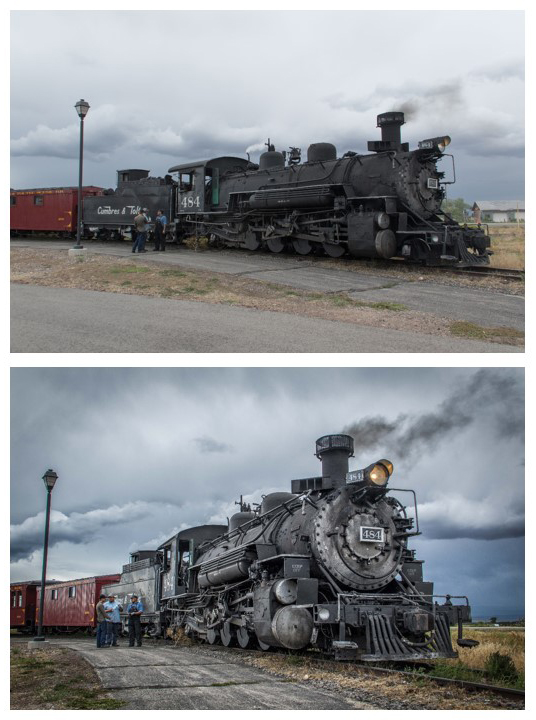
You can see what I mean from the pair of images above, made less than 30 seconds apart.  I'll admit that the bottom image has "had some work done," but even without the post-processing the bottom image conveys a feeling of power that the top one just doesn't have. 

In essence, it's the difference between documentation and interpretation.  There's a place for both in the world of photography, and I do both, but increasingly I'm aiming for interpretation:  what is the feeling I'm getting from the subject, and how can I convey that feeling visually?

Here are a few more examples.   

This is North Window Arch in Arches National Park, in a standard tourist view (documentation) and a different view (interpretation) made five minutes apart:


Here's another pair of the same arch, also made five minutes apart, but on a different day when the light had died.  Documentation versus interpretation:


     Notice the difference?


Even something as ordinary as a house under construction can become something extraordinary.  These two images were made less than a minute apart -- documentation versus interpretation:


And just for the fun of it, I got up in the middle of the night to shoot the same scene by the light of the full moon:


You get the idea:  Don't just shoot what it looks like.  Shoot what it feels like!


Wednesday, November 9, 2016

Arches in Color


North Window Arch, Arches National Park, near Moab, Utah


A day before the images of my previous post, our Road Scholar photo tour was in Arches National Park to photograph Balanced Rock, Turret Arch, and the Window Arches (north and south) at sunset.

The afternoon was filled with mixed clouds -- initially not overcast, but growing thicker by the hour.  Here's the sky at our first photo stop, Balanced Rock:


But by the time we got to the Windows section, the clouds were piling up.  This is Turret Arch:


And in the west, clouds blocked the sun, except for a small gap:


So we did the best we could with the light we had, and waited . . . hoping that the sun would move into that gap and give us a blast of direct light.  

Sure enough, it did.  We could see it beginning to emerge, and everybody was getting ready . . .


Then, BOOM!   It was like someone turned on a spotlight . . .


And then, in less than 15 minutes, it was over.


As the light faded, the North Window Arch looked like the right eye socket on the face of a giant:


If you would like to see these images (and others) in a larger format, please visit my photography website, Todos Juntos Photography, by clicking here.

Enjoy!


Saturday, November 5, 2016

Arches in Black and White


Rain is rare in Arches National Park, but on one of the two days I was there in September (as photography coach for a Road Scholar photo tour) it was overcast and raining intermittently.  Consequently, the familiar Arches color combination of ochre sandstone and blue sky wasn't available -- it was all shades of gray.

"When you lose the light, shoot black and white."  I don't know who said that, but when I got around to processing my images from the trip (of which this is the first report), it made sense to convert the rainy-day Arches images to black and white.  Here (and above) are a few examples, most from the Park Avenue section of Arches:


And, yes, there was an arch.  This is Skyline Arch from a distance (with one of our intrepid Road Scholars working on a cool reflection shot in the pool of water) . . .


and this is Skyline Arch from below:


If you would like to see these images and more in a larger format, please visit my photography website, Todos Juntos Photography, by clicking here.

Enjoy!


Thursday, September 1, 2016

Sunset Light on Awesome Clouds


Last Saturday evening we had amazing sunset light on clouds in the northeast.

The day started out clear as mixer trucks lined up before dawn to deliver concrete that would become the slab for a new house being built just across the street from our house.


(For more about pouring a slab, see my post of August, 2015, here.)


But by afternoon, the "monsoon season" clouds had rolled in, bringing scattered showers and lots of virga (rain that doesn't reach the ground).


Toward sunset, the sun finally fell below the cloud deck and shone through a gap between clouds and horizon, casting dramatic light on the Sandia Mountains, and on plants on the ground.  


And there was an interesting array of clouds to the northeast:


As the sun dropped lower, it began to illuminate the underside of the cloud deck.  The lowest hanging clouds began to light up, and a bit of a rainbow appeared:


7:21 pm MT


As the sun fell, more light shone on the clouds:


7:22 pm MT


7:23 pm MT


7:24 pm MT


7:27 pm MT


Here's a wide-angle panorama of the entire eastern sky from northeast to southeast:


7:29 pm MT


Finally, as the sun dropped below the horizon, the clouds caught fire:


7:35 pm MT


In the west, the sunset was pretty good too:


7:40 pm MT


Here's some detail from the sunset image above:


7:41 pm MT


And back in the northeast, the show was over:


7:42 pm MT


Total time:  about 20 minutes.


If you would like to see these and additional images in a larger format, please visit my photography website, Todos Juntos Photography, by clicking here.


Enjoy!