Monday, August 1, 2016

Storm Clouds


It doesn't rain much here in New Mexico.  The average annual rainfall in Albuquerque is about 9.5 inches.  Compare that with Seattle (36.15) or Boston (43.77).  So when it rains out here, it's a big deal, even when it's a small amount -- and it's usually a small amount.

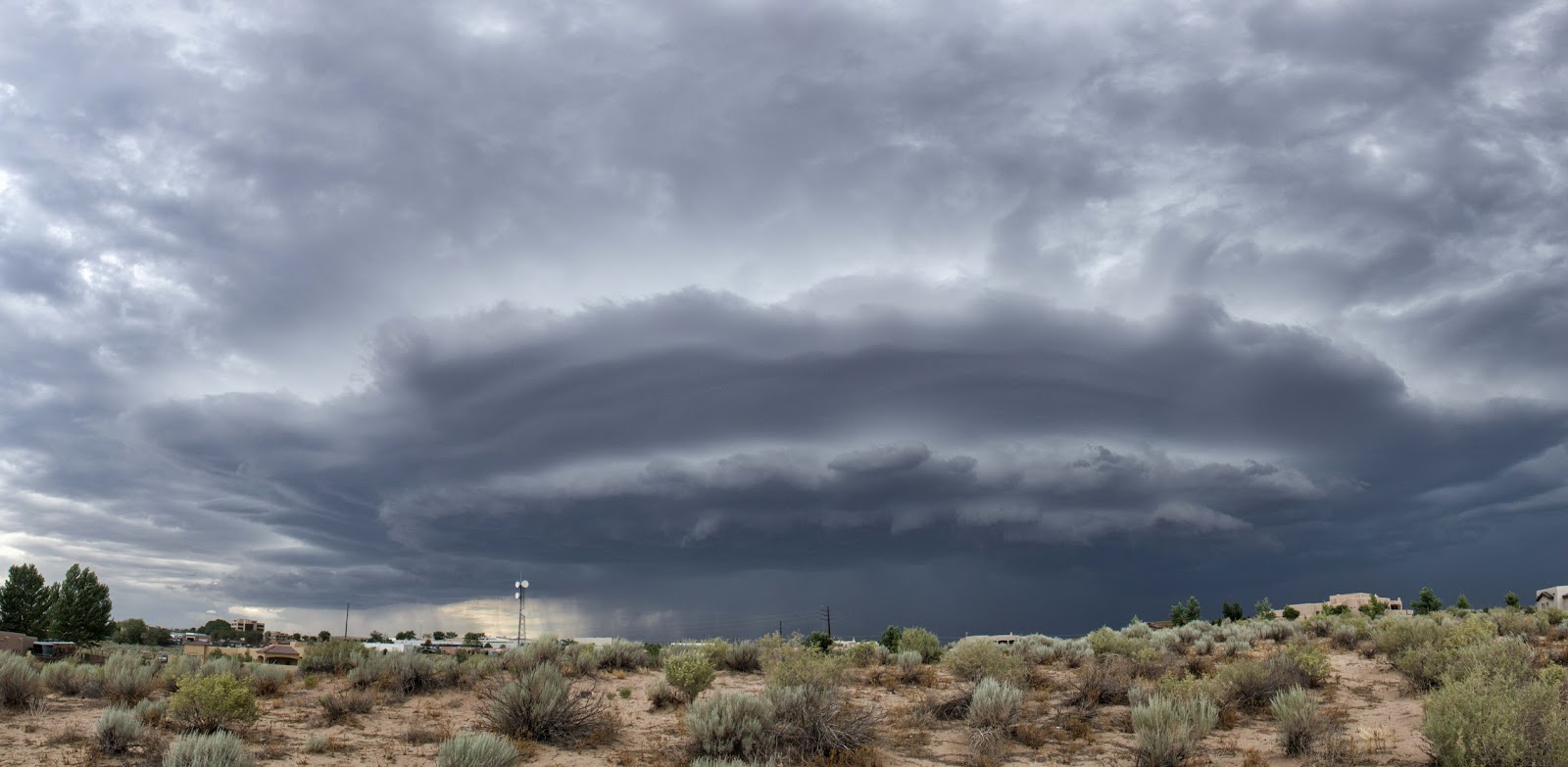
Moreover, the rain often comes in the form of very localized storm cells, rather than the blanket overcast most people associate with rain.  And on some occasions, those storm cells bring awesome looking cloud formations.  Here's one from July 21:


For scale/size estimates, the mountain peak at the far right of the image is about 10,600 ft. elevation, and the base of the mountain is at about 5,000 ft.  And the portion of the mountain you see in this image is about 5 miles long.  So I would guess the storm cloud to be about 8-10 miles in diameter, and maybe 1-2 miles high.

It never moved in our direction, so we got no rain out of it.  But last Friday (July 29), a storm cell began to form northwest of our area and in the space of about 45 minutes passed right over us.

This image is looking directly north, and you can see the core of the cell beginning to form in the lower left corner of the sky.

4:30 pm  MT

In just a few minutes, the core developed more definition and was moving in our direction as the spreading clouds ahead of it began to obscure the sun:

4:34 pm MT

Ten minutes later, the core had evolved multiple layers and was moving closer:

4:44 pm MT

4:47 pm MT


4:49 pm  MT

As usual, there was lightning ahead of the core, so at this point I retreated to the house.  About 20 minutes later, the leading edge of the core appeared overhead, preceded by wind and dust.  The image below looks ESE, and the storm front is moving in from the left (north).


5:13 pm MT

A few minutes later, it was pouring down rain.  Here's what the underside of that massive storm core looked like, looking straight up from our back yard:

5:15 pm MT

And here's what it looked like on the local TV station radar about 15 minutes later, after the core had passed over us:

5:31 pm MT
(We live northwest of Albuquerque -- on the map above, very near where those two roads intersect just below the B in "Bernalillo.")


Two and a half hours later, the storm was all gone:

7:58 pm MT

8:00 pm MT

And for all that sturm und drang, we were blessed with a whole 2/10ths of an inch of rain!

If you would like to see these images in a larger format, please visit my photography website, Todos Juntos Photography, by clicking here.

Enjoy!


Tuesday, July 5, 2016

O'Keeffe Country: The Black Place and Plaza Blanca


Tomorrow (July 6), the Tate Modern in London will open a retrospective of Georgia O'Keeffe with over 100 of her paintings, many depicting the landscape of northern New Mexico, where O'Keeffe lived most of her life between 1929 and 1986.  As Olivia Laing notes in an informative article in The Guardian a few days ago (click here), New Mexico was "the landscape that unlatched her heart."

Among the places where Georgia O'Keeffe drew inspiration for her paintings are two very different landscapes, separated by over 100 miles in northern New Mexico.  She called them "the Black Place" and "Plaza Blanca" (aka, the White Place).

I have photographed both of these locations a few times, and on the occasion of the Tate Modern exhibition thought you might like to see them and some of the art they inspired.

The Black Place

The softly rounded pillows of crumbly gray-black sediment in the Black Place began 60 million years ago as ash from volcanoes in what was then a lush tropical forest.  Iron and manganese in the soil have oxidized to give the shapes their unique color.

O'Keeffe wrote, "As you come to it over a hill, it looks like a mile of elephants -- grey hills all about the same size with almost white sand at their feet."


Most interesting, however, is how O'Keeffe's vision transformed these hills.  As Olivia Laing notes in her article for The Guardian, "the paintings tip geological form over the threshold of abstraction."

For example, here are three of O'Keeffe's many paintings of the Black Place:


Black Place I  (1941)


Black Place III  (1944)


Black Place, Grey and Pink  (1949)


Plaza Blanca

A hundred miles east of the Black Place, and only a few miles away from O'Keeffe's studio in Abiquiu, New Mexico, stand the stark cliffs and hoodoos of Plaza Blanca -- the White Place.  Contrasting with the Black Place in both color and shape, Plaza Blanca presents a completely different landscape.


The cliffs are the boundaries of a broad arroyo channel:


The walls are made of tuff, which is fine volcanic ash that has been compacted and eroded over millions of years into tower-like shapes.


Further up the arroyo, the canyon walls resemble a huge fortress city:


On the opposite side of the arroyo, the towers seem to be still emerging from the hills of other material that has been laid over the tuff:


The vertical "fins" on this side have not been smoothed as much, and are much more textured.


This section reminds me of the Sagrada Familia basilica in Barcelona:


And with a different sky and light, these towers begin to look rather ominous and creepy:


The only O'Keeffe painting of Plaza Blanca I could find online is this one, but you can see her transformative vision at work:


From the White Place  (1940)


If you would like to see these and more images of the Black Place and Plaza Blanca in a larger format, please visit my photography website, Todos Juntos Photography, by clicking here.

Enjoy!


Sunday, July 3, 2016

I Hope You Dance


                                                                                          And when you get the chance
                                                                                          To sit it out or dance,
                                                                                          I hope you dance.

                                                                                                    -- Lee Ann Womack


                                                                                          O body swayed to music, O brightening glance,
                                                                                          How can we know the dancer from the dance?

                                                                                                     -- William Butler Yeats


Every year on Fathers' Day, our little village has a family-friendly event at a local park next to the community library, featuring music and food.

This year it was sparsely attended, due to the 100-degree heat, but one couple was ready to dance.  Fortunately, I had my camera to capture some of the beauty, grace, and joy of their dance.


If you would like to see these images (and more) in a larger format, please visit my photography website, Todos Juntos Photography, by clicking here.

Enjoy!

Sunday, June 26, 2016

Bear Canyon Arroyo Dam/Spillway


Arroyos are natural channels for water that occasionally fill and flow after significant rainfall, but otherwise remain empty.  Arroyos are common in New Mexico, and in an urban area such as Albuquerque, where roads, houses, and businesses have been built, management of arroyo floodwaters is crucial to preserving property and structures.

One of Albuquerque's major arroyos is Bear Canyon Arroyo, which originates in the foothills of the Sandia Mountains east of Albuquerque and runs through the northeast part of the city.  To prevent significant flooding along the arroyo, a catch basin and dam have been built right next to a major street.  

Image courtesy of Google Earth

The dam is probably 100 yards across and 30 feet high, and the spillway (the downstream side of the dam) has an array of massive concrete blocks designed to disperse the flow of any water that might overflow the dam.  Here's what the spillway side of the dam looks like from street level:


Fans of Breaking Bad may remember this location from Season 5, Episode 11, where Jesse Pinkman waits to be picked up to leave Albuquerque:


Notwithstanding their utilitarian purpose and their service as a location for Breaking Bad, the spillway and its tombstone-like monoliths make for a visually interesting setting, ripe with photographic possibilities.

Last Thursday evening I happened to be in the neighborhood of the dam around sunset, and I had brought my camera in case the light and/or clouds were interesting.  I wasn't disappointed.

The spillway side of the dam faces west.  The sunset itself was pretty good . . .


 . . . but the best part was the pink-gold reflected light it was throwing onto the spillway monoliths and the clouds in the eastern sky above:


And, as luck (or the Universe) would have it, for photographic interest there was a woman at the top row of monoliths watching the sunset:


So she and the monoliths and the sky became my focus as the sunlight faded:


Fifteen minutes after I started shooting, the light was gone:


If you would like to see these (and more) images in a larger format, please visit my photography website, Todos Juntos Photography, by clicking here.

Enjoy!