A few weeks after our January visit to the snow-covered Black Place in northwest New Mexico, a photo buddy and I made another visit -- this time to explore the mesa surrounding the Black Place, and to see how the valley and its strange features looked from above.
The mesa is about 150 feet above the valley floor, and stretches for over a mile. The hillock features that we photographed on the previous visit emerge from the side of the mesa through erosion.
To get to the top of the mesa, we had to climb up a steep man-made path up the side of the mesa that was created for natural gas pipelines. Going up, the ground was frozen, so the footing was good; not so on the way back down (about which, more below).
The top of the mesa was what you'd expect -- a vast expanse of dirt, grass, and scrub.
And on the far side of the mesa, there was another huge range of hillocks and canyons, even larger than the ones we had explored at our starting point.
We didn't have time to explore the other side -- an adventure for another trip -- so we walked along the edge of the mesa looking down at the valley we had come from.
From above, many of the hillocks are not black at all . . .
but others have a darker layer on top . . .
and some are more thoroughly dark, depending on the angle of the light . . .
I mentioned how the strange-looking hillocks are actually multiple layers of volcanic dust that were later covered by other layers of harder sedimentary rock like shale. The top of the mesa is caprock, and the edge of the mesa is where the caprock has eroded to expose the dust layer.
The erosion continues to this day. You can see it at the eastern end of the valley of hills, where the erosion of the upper layers is still occurring. Notice in the image below how the softer layers underneath are undercutting the top layer:
When the softer lower layer gives way, the harder caprock tumbles down:
Note that this a view looking down, not horizontal. And also note the dark shale rock in the lower right corner of this photo and in the upper center of the image above it. Because this rock is harder, it will protect the layers of rock and dust below it from erosion and may become a hoodoo like these:
Eventually, of course, the softer dust below the caprock will erode, leaving the harder rocks stranded on the dusty hills, like this:
or like this one all the way down in the valley that I photographed on our previous visit:
After a couple of hours of hiking along the edge of the mesa, we had hoped to find an easy route back down into the valley. But there were none, so we backtracked to the pipeline. By now the temperature had risen above freezing, and the frozen dust was now very slippery mud.
So we each grabbed a couple of old survey stakes to use as hiking poles . . .
. . . and very slowly began to make our way down the steep, muddy slope.
The mud did a real number on our shoes, but we made it safely down without sitting in it:
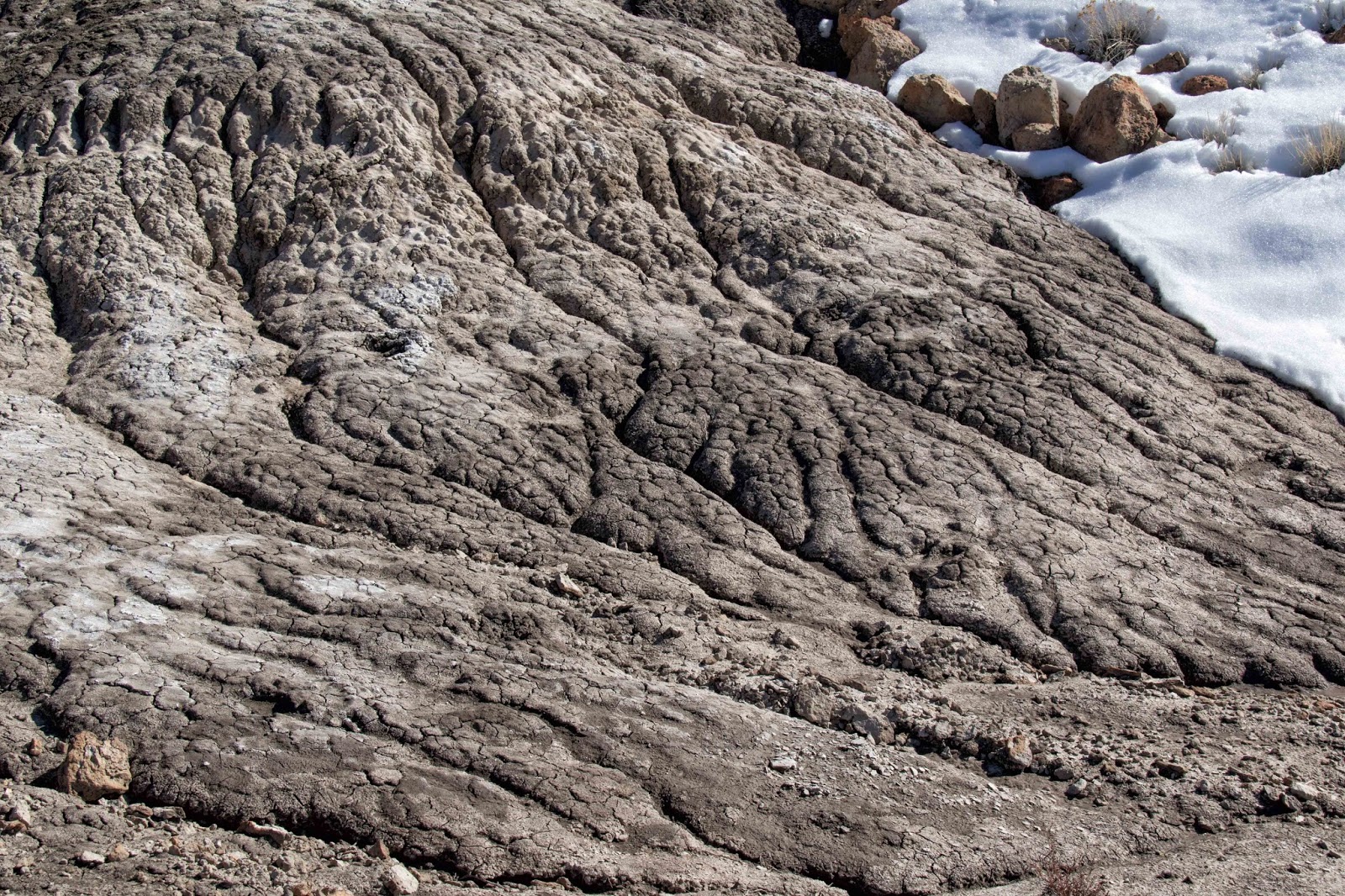
Whether up on the mesa or down in the valley, it's the volcanic dust layer that is the most interesting to me visually. It's like frozen mud, but very fragile -- it crumbles at the touch:
Back in the valley, we walked in the fantastic landscape of the hills:
And wondered at the delicate streams of water flowing from melting snow:
One last look back toward the mesa, then we headed for home:
If you would like to see these images (and more) in a larger format, please visit my photography website, Todos Juntos Photography, by clicking here.
Enjoy!
In northwest New Mexico there's an area where hillocks of gray, black, and tan emerge from the side of a large mesa. The hillocks are actually mounds of volcanic ash and dust laid down millions of years ago, then covered, and now revealed after millenia of erosion. The material is not lava -- it's caked dust, and very fragile.
The hills' dark tones are the result of oxidation of iron and manganese, and they get their crinkly "popcorn" texture from the chemical composition of the dirt. Georgia O'Keeffe called it the "Black Place," and from 1936 to 1949 visited it often to sketch and paint the weird-looking formations.
Since moving to New Mexico in 2012, I, too, have visited the Black Place many times to capture its beauty in photographs. You can read about it in a post I made last year; click here.
Earlier this year I went with a couple of photography buddies hoping to see snow at the Black Place. Our timing was good. There was only about an inch of snow, but it was enough to cover the ground and give the hills an extra range of texture and highlights. Here's a comparison. The bottom (black-and-white) image was made standing about 60 feet to the right of where I stood to make the top (color) image.
 |
| June 18, 2016 |
 |
| January 7, 2017 |
Sky conditions weren't great -- monochromatic overcast with little texture most of the time we were shooting -- so I have chosen to present the snow images in black-and-white.
First, to give you a sense of scale, in addition to the image at the top of this post, here's another view:
Here are some of my favorites from the day:
As you can see, in the basin at the base of the hills there are lots of random rocks and boulders -- mostly shale, conglomerate, and chips of lava -- left over from higher layers of rock that had been deposited on top of the layers that form the hills now.
Finally, amid all the monochrome, there were occasional bursts of color: literally rusty sand in the channel of a frozen stream of snow melt . . .
and orange lichens on a rock . . .
If you would like to see these and additional images in a larger format, please visit my photography website -- Todos Juntos Photography -- by clicking here.
Enjoy!
I am primarily a landscape photographer. But every now and then a different opportunity comes along -- like opera performances . . .
or jewelry . . .
or house construction . . .
-- and I'm willing to give it a try.
Back in June of last year, I participated in a photography workshop led by the amazing professional fine art photographer Laurie Klein (pictured below). You can visit her website by clicking here.

 The workshop was intended primarily for infrared photographers (which I am not), but I had taken one of her workshops in 2015 -- see my blog post entitled "Stretching My Comfort Zone" here -- and was ready for another good dose of creative challenges and learning experiences, so I signed up.
Turns out this workshop was all about photographing female models in natural landscapes . . . and it didn't really matter that I wasn't shooting in IR.
After a 90-minute classroom session, we went out to shoot in two locations in the bosque (cottonwood forest) along the Rio Grande a couple of miles from my house. We had
four professional models to work with, each with a different style and
vibe, and after some coaching from Laurie we all had the opportunity to
direct the models.
The workshop was intended primarily for infrared photographers (which I am not), but I had taken one of her workshops in 2015 -- see my blog post entitled "Stretching My Comfort Zone" here -- and was ready for another good dose of creative challenges and learning experiences, so I signed up.
Turns out this workshop was all about photographing female models in natural landscapes . . . and it didn't really matter that I wasn't shooting in IR.
After a 90-minute classroom session, we went out to shoot in two locations in the bosque (cottonwood forest) along the Rio Grande a couple of miles from my house. We had
four professional models to work with, each with a different style and
vibe, and after some coaching from Laurie we all had the opportunity to
direct the models.
The cool thing about working with models as subjects is that, unlike landscapes, you can pose them any way you want (within the limits of the human body). The challenge is . . . you have to know what you want, and you have to tell them. Professional models are great at translating ideas and emotions into physical postures, but they're not mind-readers: they can't do their best if you're not sure what you're after. Inevitably there's a process of experimentation and collaboration, supported by good communication, but the photographer has to lead.
First, some behind-the-scenes shots on location . . .
How many photographers does it take to set up a changing tent?
Wardrobe management:

Directing a pose:
Shooting:

And here are some of my results featuring each of the models as noted:
Felicia Davis
Tara Danielle
Colleen Fadgen

Kristenleigh Parrish
If you would like to see these images in a larger format, please visit my photography website, Todos Juntos Photography, by clicking here.
Enjoy!