Wednesday, April 1, 2020

Arizona Adventure - Part 1: Petrified Forest and Painted Desert


Last October a photo buddy (Alan Postelnek) and I took a road trip to Arizona.  Our primary purpose was to photograph a remote geological feature called White Pocket, which I had visited in 2014.  (More about that later.)  

But we decided that since we were making the trip we would visit a number of other (and better known) Arizona landscapes along the way.  In this post, and in a few more to come, I'll share stories and images from the places we explored.

First up:  Petrified Forest National Park and the Painted Desert.


This area in east central Arizona -- about 200 miles west of Albuquerque -- covers about 230 square miles of semi-desert steppe (treeless grassland) and multi-colored badlands where very little vegetation exists.


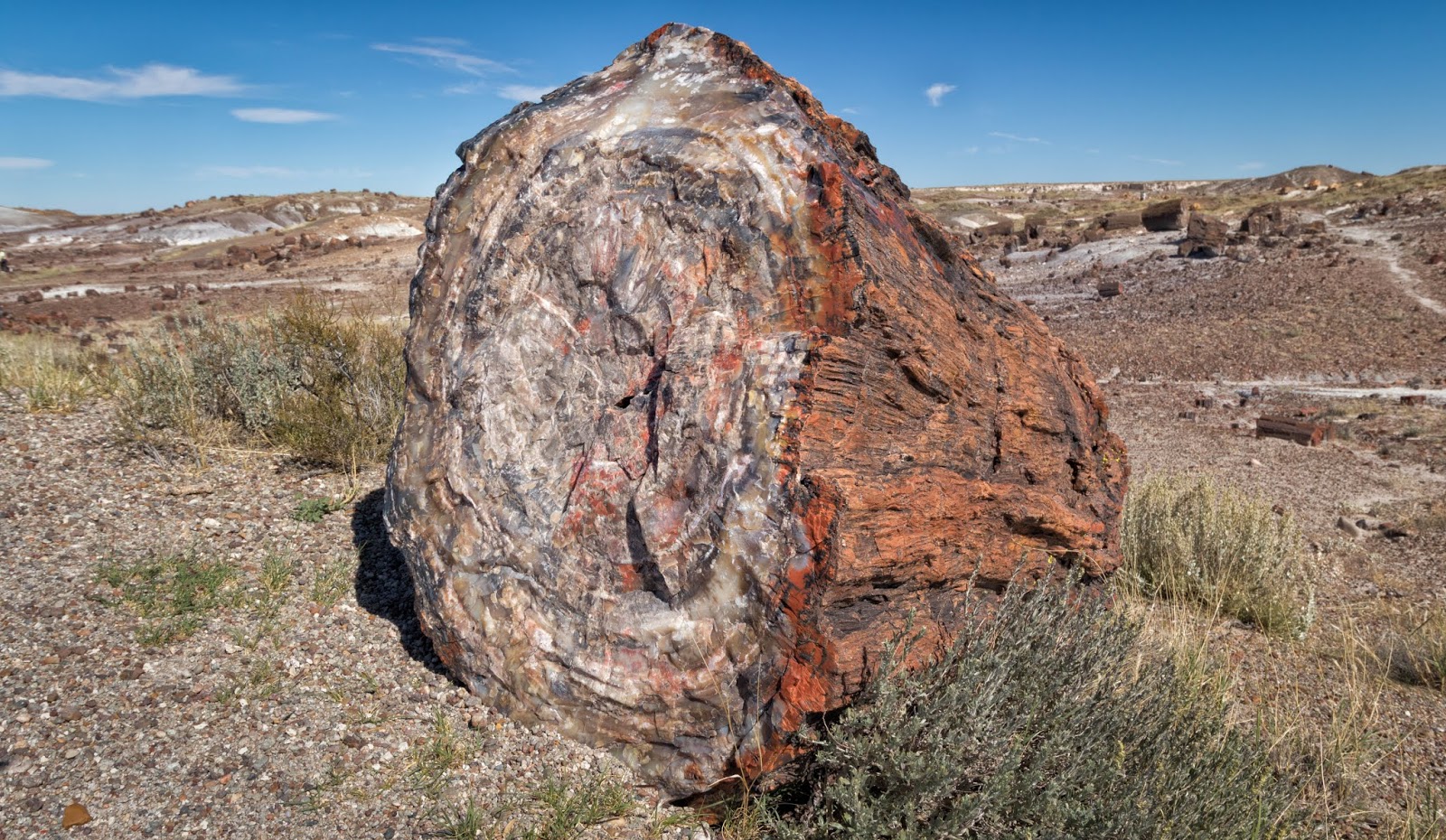
We spent most of our time in the southern section of the park, which consists of vast fields of petrified trees . . .


. . . as well as geological features of soft sedimentary rock (mud, silt, and sand) deposited by rivers, lakes, and wetlands about 225 million years ago and uncovered by erosion that began about 60 million years ago.


Much of the park's petrified wood is from extinct species of conifer trees.  Fallen trees accumulating in rivers and wetlands were buried in water-saturated sediment or volcanic ash.  Over time, the organic material in the plant (tree) was replaced by minerals in the water, resulting in a quartz chalcedony, multi-colored depending on what elements are present (such as cobalt, copper, manganese, silicon, and iron), while preserving the original plant structure and general appearance.


The process yields beautiful textures and colors.


You probably noticed that there are no unbroken tree trunks . . . they all look like they have been cut into sections.


The breaks are caused by cracks formed in the heavy quartz logs when the ground beneath them erodes and settles.  The shortest distance for a crack to grow is perpendicular to the long dimension of the log.  The log breaks like a piece of brittle chalk.


In addition to the petrified trees, the other iconic elements of the park are the colorful and interestingly-textured topographical features of soft sedimentary rock . . . which in many cases are basically dried multi-colored mud.


The most dramatic location in the park for these features is a badland area eponymously named Blue Mesa.


The features have emerged by the erosion of a layer of younger geological material on top of them.


You'll notice that, in addition to their color, the features all share the same wrinkled, elephant-skin surface texture.


The texture is created by the presence of Bentonite, an absorbent aluminium phyllosilicate clay, which swells up with rainwater, then shrinks and cracks as it dries.  It's very crumbly to the touch, so we stayed on the paved pathways to avoid damaging it.

The wrinkled features make for great visual interest, both from below and above:


If you would like to see these images (and more) in a larger format, please visit my photography website, Todos Juntos Photography, by clicking here.

Enjoy!


Saturday, November 23, 2019

Valley of Dreams


In the Ah-Shi-Sle-Pah Wilderness Study Area of northwest New Mexico there are three distinct areas of strange geological features.  The primary, and most easily accessible area, doesn't have a name (other than ASSP WSA); I have posted about it here.

The other two are "King of Wings" (see blog post here) and "Valley of Dreams" (this post).

My photo buddy, Alan, and I have visited Valley of Dreams twice.  It's a two-mile hike from where we have to leave the car, and the first time we visited it we only explored the part nearest the car.  But the far side of the area, which we visited in September, is much more interesting.

Valley of Dreams is filled with fantastic features, some of which look like the crumbling walls of a fortress . . .


There are hoodoos large . . .


and small . . .


This one even has a name; it's called "Alien Throne":


There are lots of nooks and crannies . . . 


and even some shapes we can recognize:


The top of this one reminds me of a Cubist reclining nude sculpture:


It's like the abandoned ruins of a large, medieval fortress city . . .


In addition to the large-scale features, Valley of Dreams is full of small-scale details, textures, and colors:


You might ask, "How do you find these details?"  I would answer, "I just look for them."


Here are a couple of examples.

The detail:


 and where it came from:


Another detail:


and where it came from:


In this rocky soil there's very little vegetation, but occasionally some tenacious plant will take root and bloom . . .


And not much in the way of wildlife either, though I did see a hawk . . .


perhaps hunting for this rabbit hiding among the rocks:


And on our way back to the car, we saw horses grazing on the scrubby land above the Valley of Dreams:


If you would like to see these images (and more) in a larger format, please visit my photography website, Todos Juntos Photography, by clicking here.

Enjoy!


Wednesday, November 13, 2019

King of Wings


A few months ago, when my photo buddy, Alan, and I learned of a particularly dramatic hoodoo dubbed "King of Wings," we knew we had to find it and photograph it.

Hoodoos are a common and fascinating feature of the northwest New Mexico badlands (and many other areas in the southwestern United States).  Typically they consist of a pedestal made of mudstone capped by a harder layer of sandstone which protects the softer mudstone from erosion.  


The sandstone and mudstone were once vast areas of rivers and wetlands on the western shore of the Western Interior Seaway that divided the North American continent 65 million to 100 million years ago.


Hoodoos come in all shapes and sizes.  There are short ones and tall ones, sometimes right next to each other:


Sometimes the hoodoos seem to be emerging from or sinking into the ground:


. . . and the sandstone caps look like alien eggs:


Sometimes they look like they are emerging from large mudstone walls:


Some are clustered like mushrooms:


while others stand alone:


Many sandstone caps are precariously perched:


This hoodoo is capped by a section of a petrified tree trunk:


The variations are endless.  But in some cases the sandstone cap rock is very thin and extends well beyond the mudstone base, so it looks like a wing:


The "King of Wings" hoodoo is located in a remote section of the Ah-Shi-Sle-Pah Wilderness Study Area.  (For more about Ah-Shi-Sle-Pah, see my blog post of July 1, 2019, by clicking here.)

From the highway we took a dirt road about 15 miles, then a two-track for another mile, until the two-track ended in a scrubby area populated by cows.  A quarter-mile walk led us to a great sea of undulating hills separated by steep narrow ravines -- but with no sign of any hoodoos:


There was no trail across this sea.  Fortunately, Alan had a map on his tablet, but even then it was a challenge to find a route that avoided those ravines (which were easy to get down into, but hard to get back out of).


Finally, after weaving, sliding, and climbing, we came over the top of one of those hills and looked out onto a small cluster of hoodoos where the hills descended to a broad plain:


And there at the far end was the "King of Wings":


We were there to get a sunset shot -- and maybe a "blue hour" shot as well -- so we hung around making miscellaneous images for about an hour while the sun sank slowly in the west:


Back side of "King of Wings"


Alan set up his camera for a long-exposure "blue hour" shot . . .


while I kept "walking around the teacup" looking for other ways to see the "King of Wings":


If you're wondering how far that sandstone "wing" extends beyond its support, we didn't measure it, but I would guess about 8 feet.  You can get some sense of the scale from this image:


The sun finally settled down on the horizon:


The light was soft and golden for a little while, then blue:


We got the images we wanted, but now . . . just imagine walking back to the car, over those hills and ravines, in the dark!  (We did have headlamps, but it was still challenging.)

If you would like to see these images and more in a larger format, please visit my photography website, Todos Juntos Photography, by clicking here.

Enjoy!