Monday, March 12, 2018

Bless Me, Ultima


Last month our local opera company, Opera Southwest, produced the world premiere of a new opera based on the novel Bless Me, Ultima by Rudolfo Anaya.  It's a beloved coming-of-age story set in rural New Mexico in the mid-1940s.  

Opera Southwest asked me to be the official photographer for the premiere, including a dress rehearsal as well as shooting some off-stage rehearsals and publicity photos.  I have photographed many operas for OSW over the past four years, and I was honored that they trusted me to capture this one for the record.

Photographing an opera is simultaneously a blessing and a challenge.  It’s a blessing because I’m shooting trained actors (singers) who know how to communicate emotion with their gestures, facial expressions, and body language as well as with their voices.

But it’s a challenge for me as a photographer because the event is happening in real time – no stops, re-starts, or do-overs unless the conductor says so.  People are moving all over the stage; the lighting changes frequently; and I have to be in the right place at the right time with the right camera settings to capture the moments.

The story of Bless Me, Ultima centers around an adolescent boy, Antonio, who is trying to figure out his destiny.  


His parents argue about his future:  his father wants him to become a vaquero; his mother wants him to become a farmer or a priest.


Into this conflicted household comes Ultima, a curandera -- a healer who uses herbs and traditional folk remedies.  


Ultima also has an owl who is her spirit guide.  


Antonio confides in Ultima, and she begins to teach him the ways of the curandera and the power of the natural world.


Meanwhile, the adults are having troubles of their own.  A soldier returned from World War II with PTSD (which was not well-understood in those days) has freaked out and killed another man.  A group tracks him down and, over the protests of Narciso, a peace-maker, kills the soldier. 


Antonio witnesses the murder and is traumatized.


Elsewhere, three daughters of the local barroom owner, Tenorio, practice evil rituals in the woods, 


and put a curse on Antonio's uncle (his mother's brother), who falls ill.  


When standard medicine fails, the family calls on Ultima to save him.  


With her owl spirit guide nearby (now portrayed by a singer), she cures him . . . 


but Tenorio turns the people of the town against Ultima, claiming she is a witch.  Tenorio leads a mob to Antonio's home to confront Ultima; Antonio's father blocks his path.  


Antonio's father fights with Tenorio; Narciso, the peace-maker, breaks it up and tries to de-escalate the situation, but is shoved aside.  


Ultima summons her owl to attack Tenorio.  


The owl gouges out one of Tenorio's eyes . . .


and the mob disperses.


Days later, one-eyed Tenorio confronts and shoots Narciso for intervening.  Antonio witnesses this, too, and Tenorio tries to kill Antonio, but his pistol jams and he runs away.


Narciso, dying, asks Antonio for absolution.


Antonio, once again traumatized, has a dream or a vision in which Narciso and the murdered soldier are resurrected, and Ultima's owl explains how chains of events go beyond any individual's control.


The next summer, Antonio is sent to work on his mother's family's farm, in hopes that his spirit will be restored by participating in the simple life of the farmers.  The community is full of life and joy.


In an aria, Antonio reflects on all that he has experienced.


Upon returning home, Antonio sees Tenorio once again out for revenge against Ultima . . .


and Antonio warns Ultima.  Ultima knows this is to be the culmination of the chain of events that began years before, and she reflects on her own destiny.


Tenorio arrives at night, armed and alone . . .


and Ultima summons her owl again, but this time Tenorio shoots the owl, which spells death for Ultima.  


Simultaneously, Tenorio is killed by a neighbor:


Antonio is heartbroken and cradles the dead owl, 


then asks Ultima to bless him before she dies, which she does.  


[Curtain]


The opera -- music and libretto -- was written by Héctor Armienta, a Mexican American from California who longed to bring the novel to the operatic stage and worked for years to obtain the rights.


Photo courtesy of Héctor Armienta website


Narciso was sung by Javier Ortiz.


The Owl was sung by José Luis Muñoz.


Antonio’s mother and father were sung by Carelle Flores and Javier Abreu.


Tenorio was sung by Carlos Archuleta.


Antonio was sung by Daisy Beltran, a 15-year-old Albuquerque girl making her opera debut.


Ultima was sung by Kirstin Chávez, an Albuquerque-born versatile and veteran singer.  Her singing and stagecraft were wonderful.


The stage director was Octavio Cardenas.  


The orchestra conductor was Guillermo Figueroa.


If you would like to see these images -- and many more -- from the opera in a larger format, please visit my photography website, Todos Juntos Photography, by clicking here.

Enjoy!


Wednesday, March 7, 2018

Send in the Cranes


                                                                                                             Isn't it rich?
                                                                                                             Aren't we a pair?
                                                                                                             Me here at last on the ground,
                                                                                                             You in mid-air . . .


Ever since we moved to New Mexico, locals have encouraged us to go see the sandhill cranes that migrate to central New Mexico every fall to spend the winter in fields and wetlands along the Rio Grande.  But it's never been a high priority for me:  landscapes and great vistas speak more to me than birds.

Finally, however, one of my photo buddies (and former PBS colleague) Bruce Shah prevailed on me to go with him, having been captivated himself by the cranes and their other-worldly call (about which more below).

Nowadays, because the Rio Grande water flow is being managed for agriculture and other uses, the birds' natural habitat no longer exists to any great extent.  Fortunately, conservation and wildlife lovers prevailed, and two waterfowl management areas were created along the river:  the more well-known is Bosque del Apache, run by the U.S. Fish and Wildlife Service south of Socorro, NM; the other is the Ladd Gordon Waterfowl Complex, run by the New Mexico Department of Game and Fish, north of Socorro.

Bruce and I made three trips to the Ladd Gordon area, twice in mid-December and once in January.

Our first visit was on a bright, beautiful afternoon, when thousands of cranes returned to the wetlands from a day of feeding elsewhere.  You can see them coming from miles away, and they literally fill the sky.


As the cranes arrive they fly right overhead -- wave after wave after wave:


You get the idea.

The cranes settle down to spend the night in wetland ponds and fields:


While we were watching, some knucklehead in an ultra-light aircraft buzzed the ponds, frightening the birds back into the air.  You can see him on the right-hand side of the image below:


No birds were injured, as far as we could tell, but we really wanted to shoot the guy down.

As the sun set, the birds walked around gingerly foraging in the water and the reeds . . .


 . . . all the while calling to each other.  Listen to their other-worldly calls by clicking on the "Play" arrow below.


Our second visit was in the morning, so we could photograph the cranes' fly-out.  As luck would have it, there was fog everywhere, which created an interesting environment for photographing the cranes.


As the sun came up, the fog began to dissipate and the color of the light changed:


After a while, many of the birds had left the wetland pond and moved to a nearby field to feed on corn that had been planted, then chopped down for the birds to eat.


In addition to the cranes, the fields and air also hosted snow geese:


Eventually, the cranes joined the geese and flew off to eat elsewhere, and we called it a day.


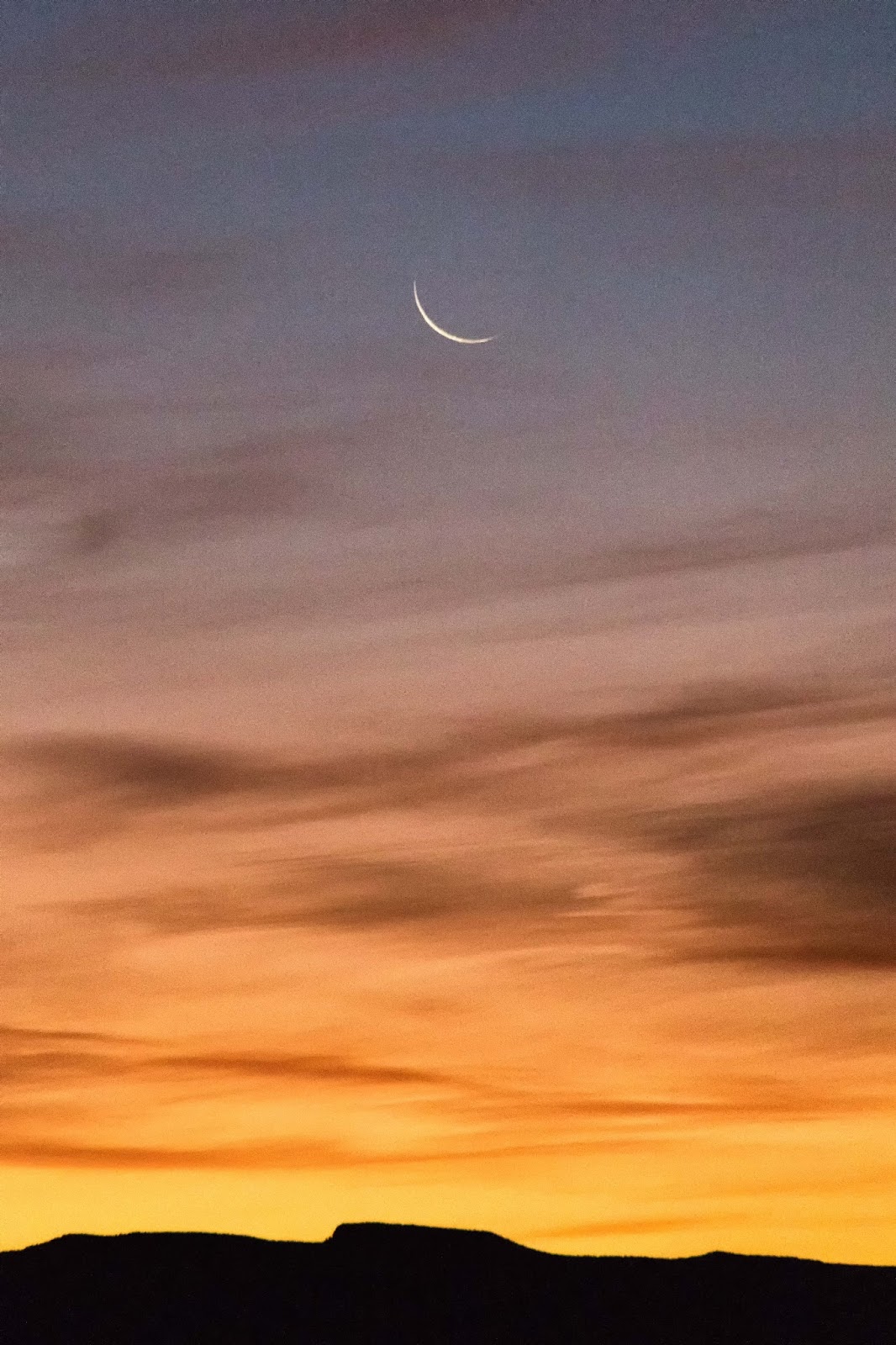
Our third visit was also a morning shoot, but this time we had a clear sky with a beautiful crescent moon . . .


. . .  and a gorgeous sunrise to serve as a background for flying cranes:


By early February, the cranes had all departed, heading north to their summer homes in Canada and Alaska.  But we are happy to host them for the winter in New Mexico.


If you would like to see these and other images in a larger format, please visit my photography website, Todos Juntos Photography, by clicking here.

Enjoy!


Thursday, January 18, 2018

Road Scholar Photography Trip


Each fall and spring I serve as photography "coach" for a Road Scholar bus trip to national parks and other photogenic locations in southern Utah and northern Arizona.

I have written about these trips before, so this blog entry will simply recap the locations we visited last September and, I hope, pique your interest with an image or two from each.

You can see more images from each area at my photography website, Todos Juntos Photography, by clicking here.  Or, even better, come join us on the trip by clicking here.  (The April 2018 trip is full, but there is a wait list; September trip still available.)

Zion National Park

Thousand-foot high cliffs of Navajo sandstone . . .


carved by the Virgin River running through them . . .


Bryce Canyon National Park

Not really a canyon, but rather a series of amphitheaters of spires and hoodoos left from the eroding east side of the Paunsaugunt plateau.


Capitol Reef National Park

A beautiful, less well-known and less well-explored national park . . 


Canyonlands National Park

We caught this one on a rainy day in the desert . . .


Arches National Park

Thousands of arches and windows, tiny to huge . . .


Monument Valley Navajo Tribal Park

The iconic "western" landscape, featured in dozens of films.  This location is called John Ford Point.


Lower Antelope Canyon Navajo Tribal Park

One of the most amazing and beautiful places I have ever seen -- a slot canyon created by the hand of nature, not the mind of human beings.


Hope you enjoyed the tour!  See these and more at my website by clicking here.