Thursday, April 21, 2022

Frida - Opera Southwest


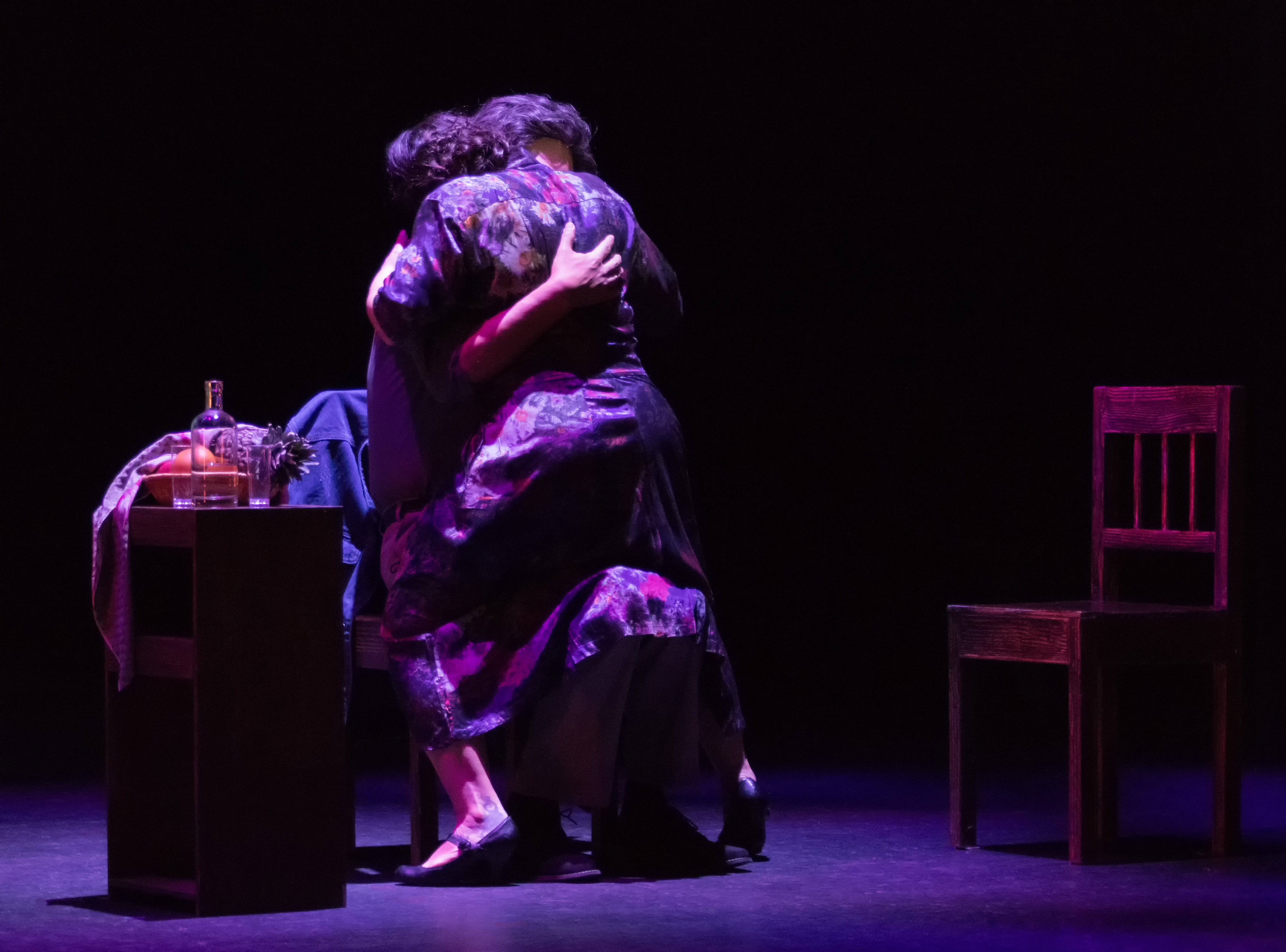
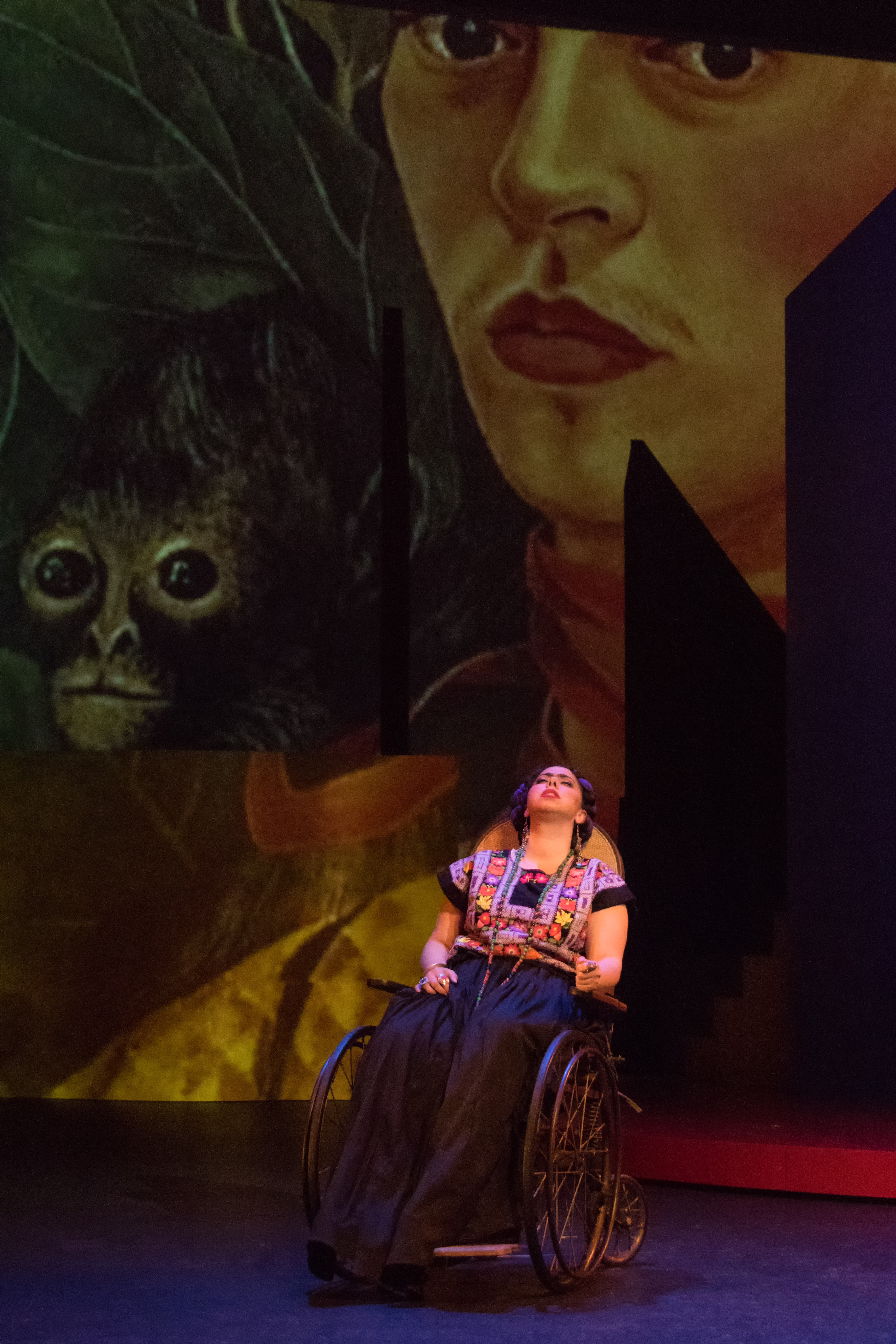
After a two-year hiatus caused by the Covid pandemic, in February I returned to opera photography at the dress rehearsal for Opera Southwest's production of Frida, based on the life of Mexican painter Frida Kahlo (1907-1954).  The opera premiered in 1991, and since then has been produced at the American Repertory Theater (Cambridge, MA), the Brooklyn Academy of Music, Houston Grand Opera, and many others.


During the 2.5 hour production I shot over 2,000 images, and winnowed them down to about 400 which are available for viewing at my photography website, Todos Juntos Photography, here.  For this blog post, however, I'll just share a brief synopsis and selected images from the production.


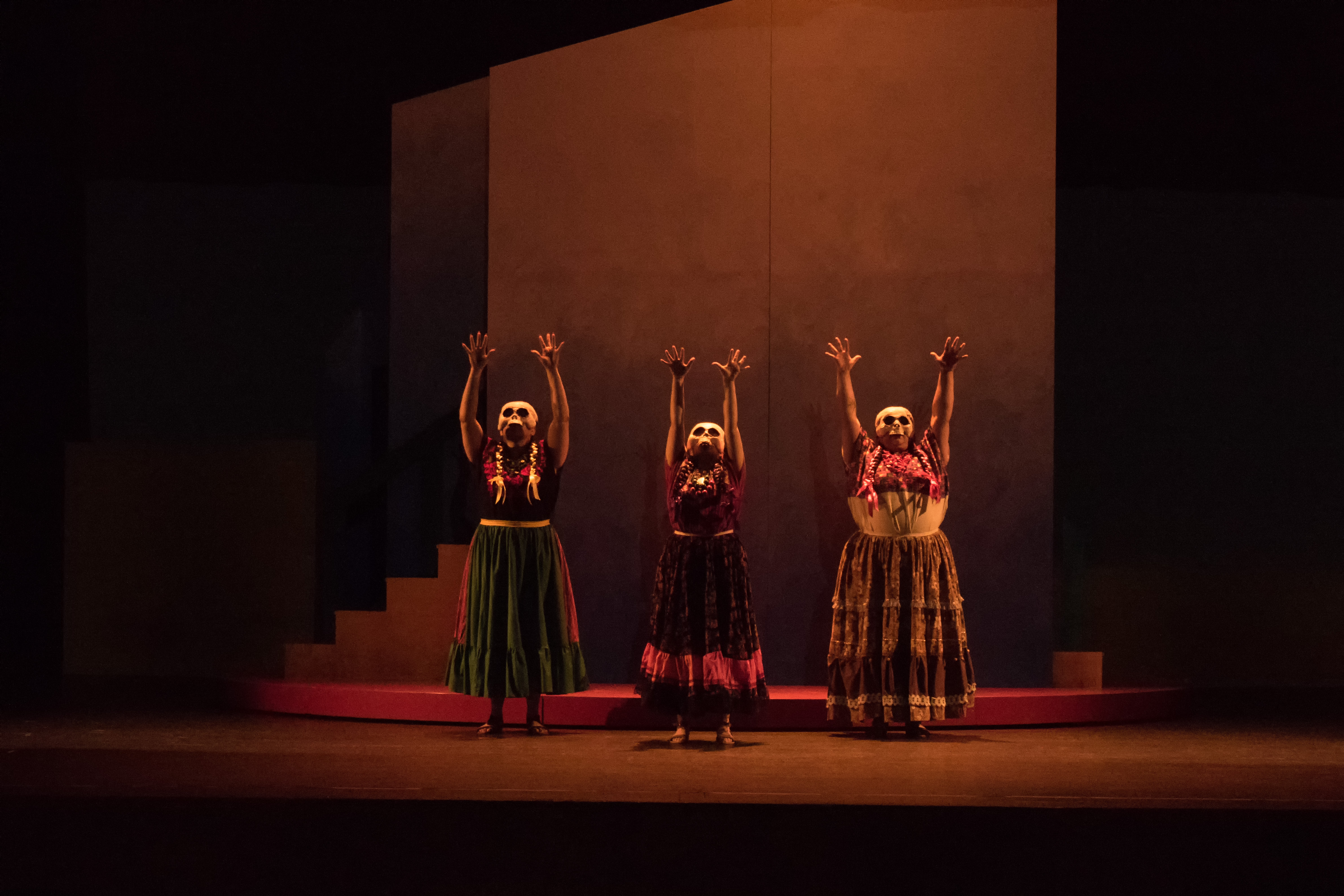
The opera opens with a dramatic image of three muertes (death figures from Mexican folklore) wearing calaveras (skull masks), who reappear throughout the opera.


The opera then chronicles Frida's life from her schoolgirl-hood . . .


 . . . to her first encounter with death in the form of a peasant woman's dead child . . .


and the awakening of her social consciousness in the Zapatista movement.


At age 18 she was in a bus accident that left her severely injured and in lifelong pain.


During her three-month convalescence, Frida took up painting . . .


then introduced herself to the famous Mexican muralist Diego Rivera, twenty years her elder . . .


. . . whom she married after he divorced his second wife.


Rivera was a member of the Communist party, but the political climate in Mexico turned against him . . . 


. . . so he and Frida decided to try their luck in the United States.  In the early 1930s they arrived in New York and were fĂȘted by John D. Rockefeller, Jr. and Edsel Ford.


In Detroit, while Rivera worked on a massive mural in the Detroit Institute of Arts, Frida suffered a miscarriage and spent two weeks recovering in Henry Ford Hospital.


When Frida and Diego returned to Mexico, her painting flourished . . .


. . . and he engaged in numerous extramarital affairs, including one with Frida's sister.


In retaliation, Frida had affairs of her own, including one with Leon Trotsky, exiled from the Soviet Union to Mexico . . .


. . . quarreled with Rivera . . .


and explored other aspects of her sexuality.


Eventually, she and Rivera divorced, and, haunted by her physical and emotional pain, she created surrealistic autobiographical paintings while restricted to a wheelchair and bed.


The opera ends when, a little more than a year after their divorce, Frida and Diego are reconciled and remarry.


If you would like to see these images -- and many more from the production -- in a larger format, please visit my photography website, Todos Juntos Photography, by clicking here.

Enjoy!


Tuesday, February 8, 2022

Snow and Sky at San Carlos Cemetery


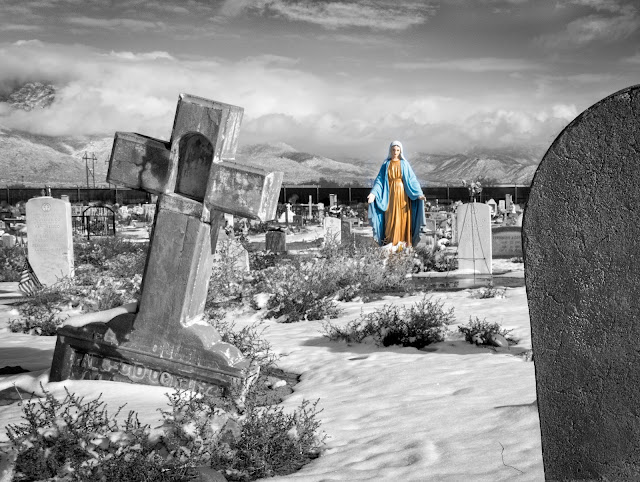
The winter storm that barreled from New Mexico to Maine last week dropped about 4" of snow in the Albuquerque area, making travel slow and dangerous.  (Some of our towns don't have any snow removal equipment; they just rely on the sun to melt it all!)


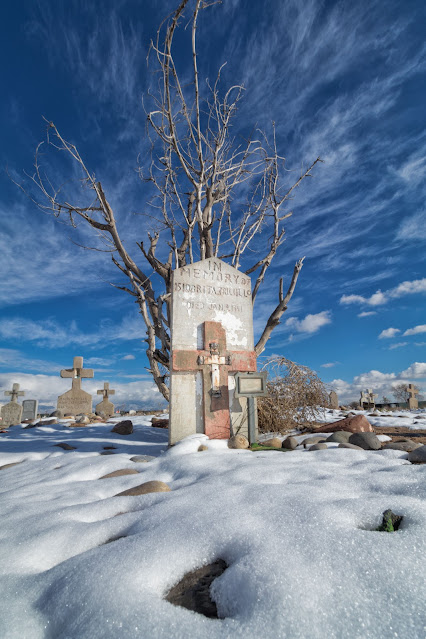
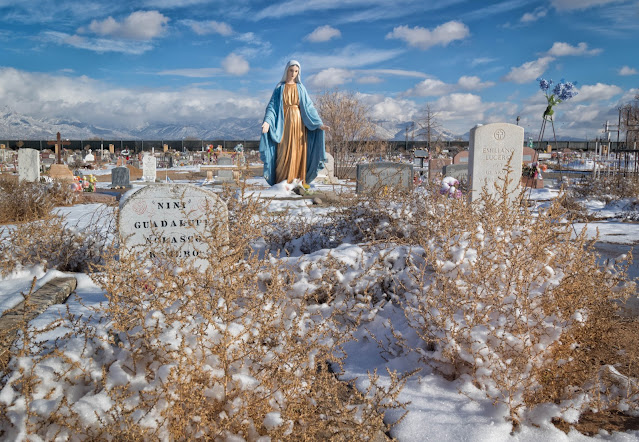
But as the storm moved out, the snow was followed by a deep blue sky with some beautiful clouds, which provided a rare (for New Mexico) combination of snow and sky for me to photograph at nearby San Carlos Cemetery.  


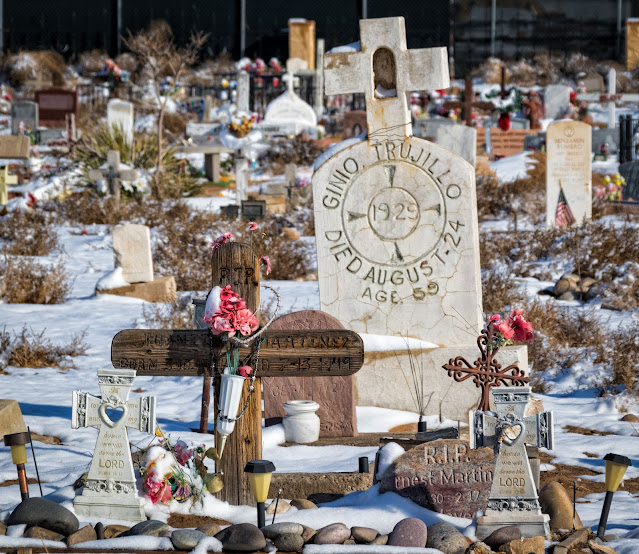
The photographic challenge with this cemetery (and many others) is getting visual separation -- that is, having a clear, distinguishable subject for a photograph when the background (or foreground) is filled with other objects.


For example:


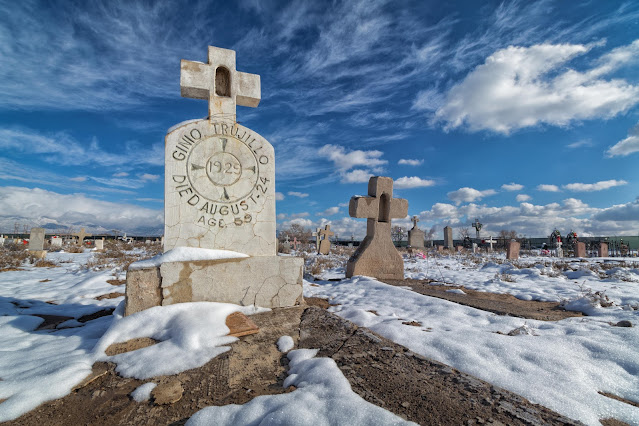
You would probably guess that the headstone for Ginio Trujillo is the subject of this image, but it's got a lot of competition for the viewer's attention.  


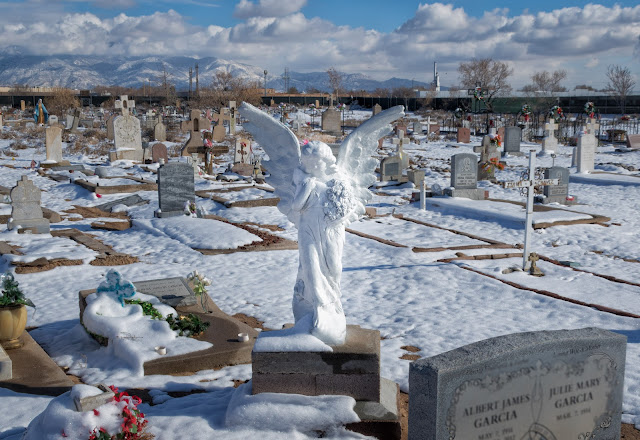
Similarly, you'd probably say that the angel in the center of the image below is the subject, yet here too there is a lot of competition for your attention:


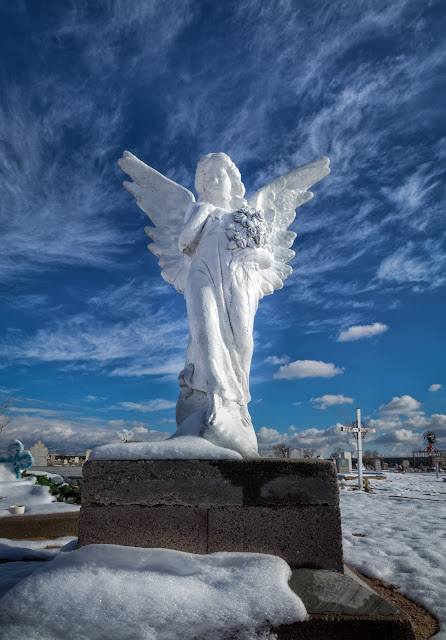
My best strategy for achieving separation is to find a point of view that leaves most (if not all) of the other stuff out of the frame.  Frequently -- especially in cemeteries -- that means getting on the ground and shooting upwards from below, with the sky as background.  So here's Ginio Trujillo . . .


and that angel . . .


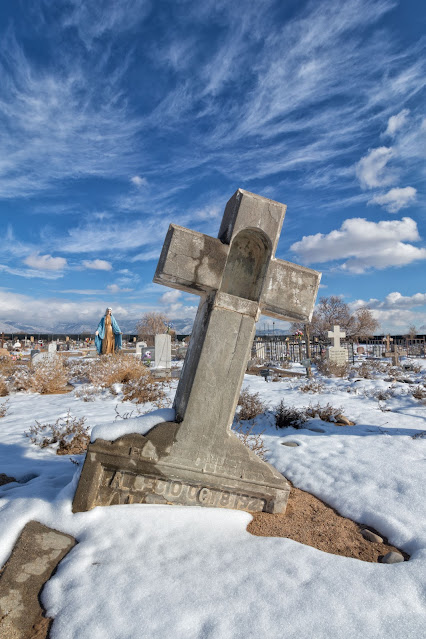
On this day, fortunately, I had the benefit of fantastic clouds in what ordinarily in New Mexico would be an empty and uninteresting sky.  Thus . . .


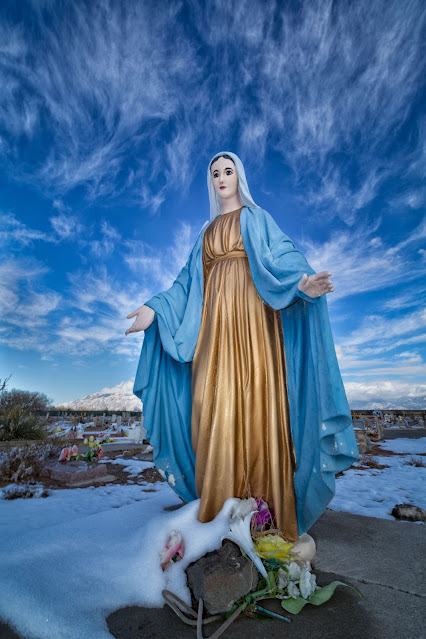
In the image above, you might notice a colorful figure in the background (to the left of the leaning cross).  This statue is one of my favorite subjects in San Carlos Cemetery, so I made my way over to her:


Just as I got close to her, a big cotton-y cumulus cloud covered the sun, and suddenly, in effect, I had "blue hour" light.  Framing her against the streaky cirrus clouds, I got my shot:


If you would like to see these images in a larger format, please visit my photography website, Todos Juntos Photography, by clicking here.


Enjoy!
Tuesday, February 1, 2022

The Peace of Wild Things


When despair for the world grows in me
and I wake in the night at the least sound
in fear of what my life and my children's lives may be,
I go and lie down where the wood drake
rests in his beauty on the water, and the great heron feeds.
I come into the peace of wild things
who do not tax their lives with forethought
of grief.  I come into the presence of still water.
And I feel above me the day-blind stars
waiting with their light.  For a time
I rest in the grace of the world, and am free.

                              Wendell Berry, "The Peace of Wild Things"


Every year, for who knows how many centuries, sandhill cranes and snow geese come from Alaska and Canada to winter in the central New Mexico valley of the Rio Grande river.  And for most years since moving to New Mexico, I go to be in their presence, usually at the Ladd S. Gordon Waterfowl Complex near Bernardo, NM.  You can see my earlier posts and images here and here.


This season I made four visits with my friend, Bruce Shah:  one in November, one in December, and two in January.  Frequently there are other photographers present, with tripods and big long lenses.  I shoot hand-held with my 18-300 on a crop-sensor Canon 7D Mark II, which gives me all I want.


The rhythms of the birds' days are always the same:  hanging out overnight in wetlands near the Rio Grande . . .


. . . until the sun rises, when they begin to take off in search of feeding grounds elsewhere.


The cranes tend to leave in small groups . . .


 . . . but the snow geese often leave in a mass ascension.


They take a turn around the pond, wheeling about, then fly away for the day:


By 8:00am, the birds are almost all gone, and the pond is empty:


In the afternoon/evening, the sequence is reversed as birds return to their overnight locations.  At first, just a few . . .


 . . . and then more and more.


They circle the pond and line up for landing:


Beyond documenting the birds' behavior, from a purely photographic/artistic perspective I look for opportunities to capture them in beautiful light -- in particular, the light on the birds' bodies and wings immediately after sunrise or just before sunset.  Here are some examples:


In addition, if there are clouds or other elements in the sky, I try to use them as well:


Best of all, on two visits I had the moon to work with -- waxing moon in the afternoon . . .


. . . and the full wolf moon setting in the morning:


I hope these images bring you into the peace of wild things and give you rest in the grace of the world.


If you would like to see these images in a larger format, please visit my photography website, Todos Juntos Photography, by clicking here.