Friday, June 18, 2021

Covid Respite #21 - East Mountains Ramble


                                                                Houses rise and fall, crumble, are extended,

                                                                Are removed, destroyed, restored, or in their place

                                                                Is an open field . . .


                                                                                -- T. S. Eliot, "East Coker" in Four Quartets


There's a small north-south chain of mountains east of Albuquerque.  North of I-40 they're called the Sandia Mountains; south of I-40 they're the Manzano Mountains.  Collectively, they're referred to as the East Mountains.

A couple of weeks ago, for my 21st (and perhaps last) Covid Respite trip, my friend, Bruce, and I took a day trip to photograph some of the scenery on the other side of those mountains.

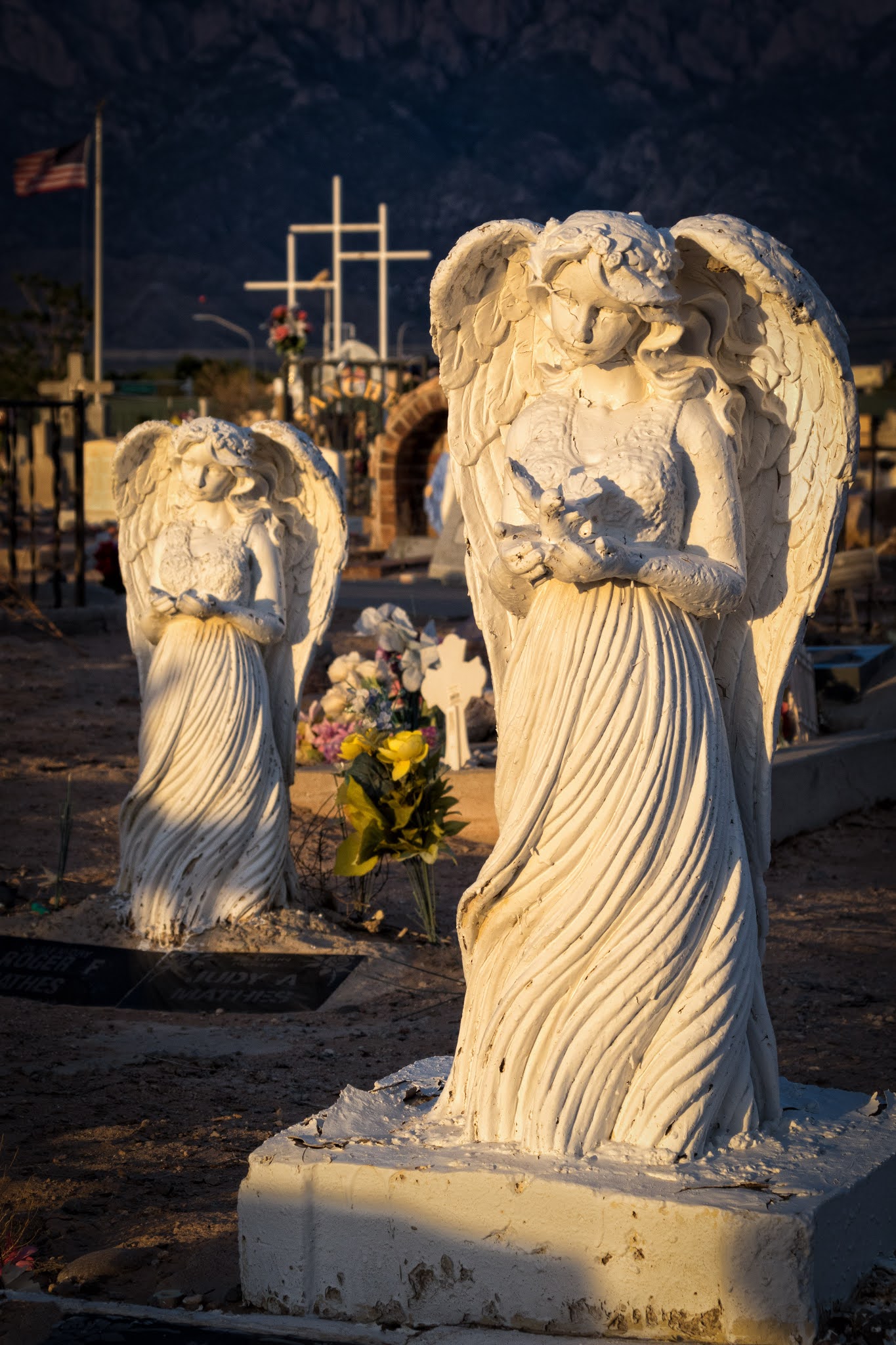
We visited and photographed two small-town cemeteries (Chilili and Willard) . . .


. . . one of the three Salinas Pueblo Mission National Monument sites (Quarai) . . .


a small church in the village of Punta de Agua . . .


. . . and an old Sears and Roebuck catalog house outside of Estancia. 


And of course our trip would not be complete without an abandoned pickup in an empty field.


Here's a map of our route:


As you might have noticed, we had two very different skies to work with.  Morning was clear and bright, with only a few clouds.  The afternoon sky filled with low clouds which provided a 5-minute shower between Willard and Estancia (I actually had to turn on my windshield wipers!) and a dramatic look for the cemetery and old house images.


So here are a few images from each location, starting with the Campo Santo de Chilili, which we visited twice -- once outbound, once on the return.


Chilili, NM, Cemetery - Morning


God is love, but vandals better watch out:


Salinas Pueblo Mission National Monument - Quarai Site


The Quarai Mission church and convent were built between 1627 and 1632.  (Note, friends, that this was only 7-12 years after the Pilgrims arrived in New England.)  These were Spanish settlements, and as with the other Salinas Mission sites, a combination of disease, drought, famine, and Apache raiding led the Spanish to abandon Quarai in 1678.  The area was resettled by Mexicans and Spanish about 1820, and then burned by the Apaches in 1830.


San Vicente de Paul Catholic Church - Punta de Agua, NM


A couple of miles from the Quarai ruins is the little village of Punta de Agua, and its classic Roman Catholic church built in 1878.


Classic New Mexico Icon


Between Punta de Agua and the Quarai ruins we spotted this old pickup.


Willard, NM, Cemetery


As we arrived in Willard about 1:00pm, the clouds were building up . . .


This one looked like a good candidate for black-and-white (and a slightly different composition):


Within half an hour, the sky was filled with dark lowering clouds -- great for much more dramatic and emotional images.


Notice the lizard in lower left


Ayers House, Estancia, NM


This is a classic New Mexico scene that has been photographed thousands of times, but I'd never been to it until this trip.  Apparently you're not a true New Mexico photographer until you've photographed this house.


The house was built from a DIY kit ordered from the Sears Roebuck catalog in the early 1920s, so it's about 100 years old now.  Here's a video with a bit more of the story -- click here.


Chilili, NM, Cemetery - Afternoon


The clouds were still hanging around by the time we returned to the Chilili Cemetery on our way home, providing a completely different look from our morning visit . . . and requiring a different compositional strategy:  on the ground looking up.


Finally, although vandals had been warned, we were relieved to see that photographers were welcome:


Returning home, we capped off our trip with a great sunset:


If you would like to see these images in a larger format, please visit my photography website, Todos Juntos Photography, by clicking here.


Enjoy!

Tuesday, June 8, 2021

Covid Respite #20 - San Carlos Cemetery in Gold and Blue


A couple of weeks ago for my Covid Respite #20 I revisited San Carlos Cemetery.  My previous visit to the cemetery -- Covid Respite #18 with my UNM Continuing Ed class -- was a mid-afternoon shoot, so not the greatest light for beautiful photos.  (You can read about that shoot by clicking here.) 


This time I went during the period just before and after sunset from 7pm to about 8:30pm -- the "golden" and "blue" hours.  I accompanied Kirk Gulledge, an Albuquerque friend who now lives in Florida and returns for visits occasionally.


Light can dramatically affect the mood or "feel" of an image, so it was interesting to shoot in different light and see the differences from the previous visit in a couple of shots:


I wasn't trying to shoot these exactly the same way, but composition obviously makes a difference too.


Here are a few images from the "golden hour" right before sunset:


After sunset, of course, comes the "blue hour," one of my favorite times to photograph anything outdoors.  On this evening we were also fortunate to have an almost-full moon to work with.


If you would like to see these images in a larger format, please visit my photography website, Todos Juntos Photography, by clicking here.

Enjoy!


Saturday, May 29, 2021

Covid Respite #19 - Night Photography at City of Rocks State Park


                                                                            "My God, it's full of stars!"  -  2001: A Space Odyssey


Out on an empty plain in the Chihuahuan desert area of southwest New Mexico, about a 5-hour drive from Albuquerque, there's an unusual one square mile outcropping of huge rocks.  It's protected as a state park called "City of Rocks."


My friend, Bruce, wanted to visit the park to do some night photography because it is a "dark sky" site where the stars and Milky Way are much more visible than in an urban area.  So I tagged along for my Covid Respite #19.


From a distance, it just looks like a mess of rocks . . . which it is.  The rocks were formed about 35 million years ago when a very large volcano erupted.  Erosion over millions of years slowly formed the sculptured columns now visible.


But up close you can see that these are giant boulders and pinnacles, some reaching 30-40 feet high.  Here's our campsite:


We arrived about two hours before sunset, and after a quick supper of cold Subway sandwich (me) and Whole Foods chicken salad (Bruce), we began to scout for locations that would make good foregrounds to frame a starry sky and hopefully the Milky Way.


We had to reserve our overnight campsite a couple of weeks in advance, but fortunately the sky was clear, with just a few clouds out on the northern horizon, giving us beautiful "golden hour" and "blue hour" light before the stars appeared.


A couple of hours after sunset, the stars appeared:


You might be wondering how the rocks could be so visible in the dark:  starlight is bright, but not that bright.  The answer is that we had a first quarter moon setting in the west which provided a surprising amount of light on the landscape.  The Milky Way, however, was not yet up in the east.  So we went back to our campsite and snoozed for a few hours.


When we awoke a little after 4:00am, the Milky Way was directly overhead and the "galactic center" was visible above the southern horizon.  We scrambled to get our shoes on and our cameras and tripods set up, because in less than an hour sunlight scattered by the Earth's atmosphere would overwhelm the starlight.


Here's what the galactic center looked like at 4:30am:


At 4:58am it was fading fast with the light of the coming dawn:


Hungry and in serious need of coffee, after sunrise we packed up, grabbed a hot breakfast and coffee in Silver City, NM, then headed home.


If you would like to see these images in a larger format, please visit my photography website, Todos Juntos Photography, by clicking here.


Enjoy!


Wednesday, May 19, 2021

Covid Respite #18 - San Carlos Cemetery


Cemeteries are among my favorite places to visit and photograph.  They are full of hints about the lives of the people who are buried there, and in New Mexico many are replete with decorations and symbols of remembrance that lighten the inevitable sadness that accompanies the loss of a loved one.


My recent visit to a local cemetery for this Covid Respite has a long gestation story.


As many of you know, I teach an introduction to digital photography class at the University of New Mexico Continuing Education department.  During the pandemic, of course, we've had to move the class online.


In the past, it has been a two-part class of two hours once a week, with a homework assignment in between.  But even before the pandemic, I had been toying with the possibility of adding a field trip (live, not virtual) to the course.  When the pandemic hit, that idea had to be set aside, but as things began to improve, I was able to restructure the class and include an in-person field trip for a class this spring.


The field trip was to San Carlos Cemetery, a large cemetery not far from Balloon Fiesta Park north of Albuquerque.


It's a classic New Mexico cemetery with a lot of dirt and weeds, poured concrete headstones or simple wooden crosses with names and dates scratched in by hand.


But many of the graves are decorated with flowers and mementos, from elaborate to simple:


And the decorations range from religious/spiritual to quotidian, sometimes on the same plot:


Eight out of the ten students participated in the field trip, including one (and her husband) from Santa Fe and one from Ft. Defiance, AZ,  in the Navajo Nation on the border between New Mexico and Arizona (a two and a half hour drive away).  That's what I call dedication.


We were there in the early afternoon on a typical New Mexico day:  hot, very windy, and mostly cloudless -- not the best conditions for great photographs.  But the goal was to give the students an opportunity to practice using their cameras and, with luck, to apply some of the things they had learned in the class.  I was there to encourage and consult.


The students made some good images, and it was fun to review them in the follow-up class session and see what they saw.  Here are a couple of examples:


Courtesy of Meredith Kent


Courtesy of Deborah Conlon


One student photographed a statue and I happened to get a picture of her as she was shooting it:


Courtesy of Kris Monaghan


Besides yielding interesting images, the field trip also serendipitously provided three images to illustrate how point-of-view (POV) can make a big difference in what an image communicates.


Among all the gravestones and decorations, I photographed a very large and colorful statue on one grave:


Here's how two different students photographed her:


Courtesy of James Padilla


Courtesy of Leslie Dietz


Note how the POV, as well as the placement of the statue within the frame, communicates something different in each image.


I'll close here with three images that tell a sad but perhaps redemptive story, beginning with the image at the top of this post:


On the cross, it says 

                                                                       Maria Duran

                                                         July 25, 1945  -  July 26, 1945


Nearby is a similar cross, with a similar inscription:


                                                                     Rosemary Duran

                                                          August 30, 1945  -  April 6, 1946


And next to that one, another:


                                                                 Antonette Dianna Duran

                                                            June 7, 1947  -  June 14, 1947


I'm not sure how these three are related, since Maria and Rosemary appear to be born five weeks apart, while Antonette was born almost a year later.  However, an online genealogy shows these three as children of Floran and Maria Duran, and gives Rosemary's birth date as August 30, 1944 (rather than 1945).  So it's possible that Rosemary's birth date on the cross is incorrect; if so, the birth dates make more sense:


            Rosemary:  August 30, 1944 - April 6, 1946

            Maria:  July 25, 1945 - July 26, 1945

            Antonette:  June 7, 1947 - June 14, 1947


But whatever terrible circumstances cut these lives so short, I am heartened that today, 75 years later, someone still remembers and cares enough to put flowers on their graves.


If you would like to see these images and more in a larger format, please visit my photography website, Todos Juntos Photography, by clicking here.